Hell on Earth.
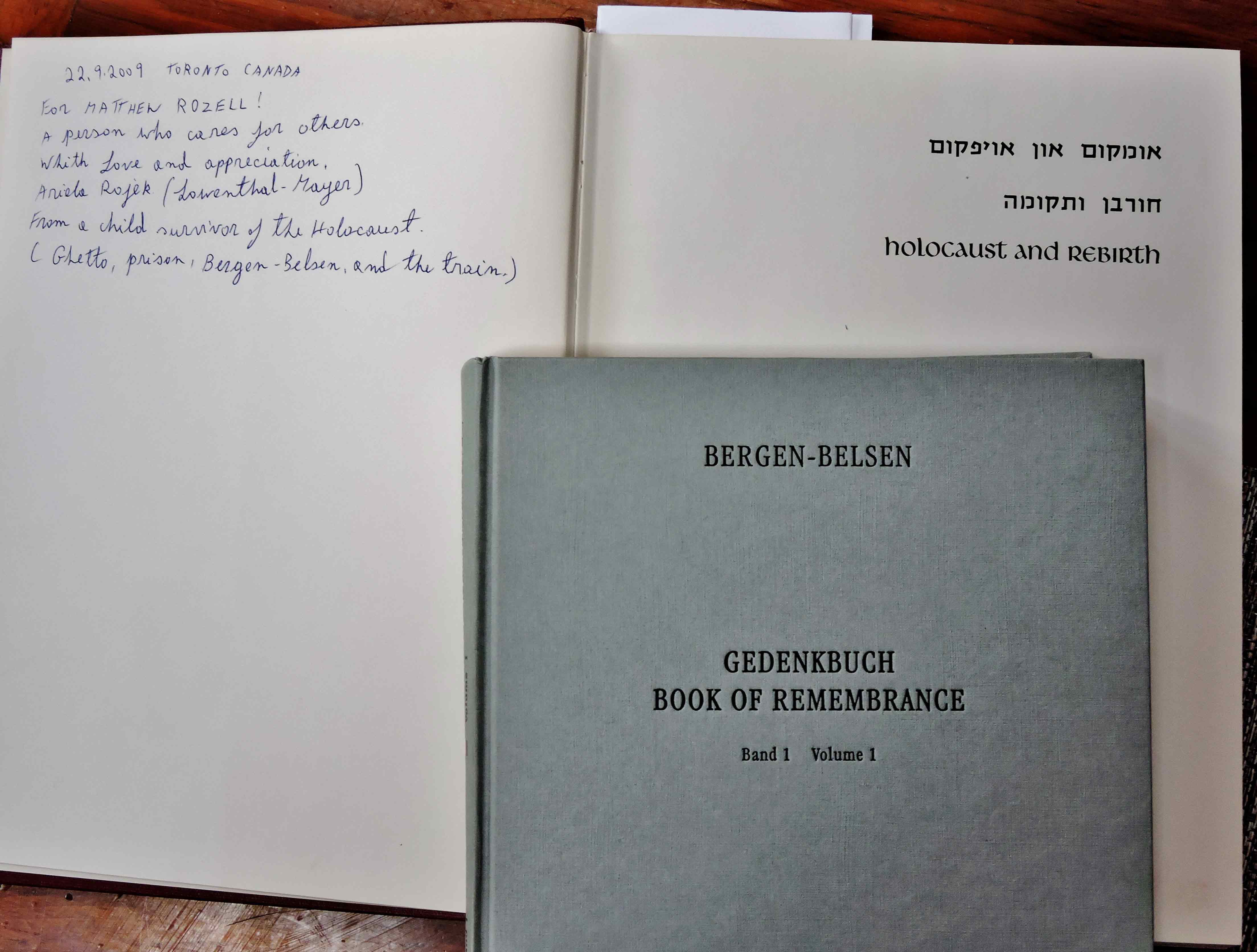 Some of my research material. Books presented to me by my friends at the 2009 reunion; the 20th anniversary commemoration of the liberation of Bergen Belsen book, and Volume 1 of the Book of Names, an attempt to compile the list of all those who suffered here.[/caption]
I learned a lot. Sometimes you wonder how much you take for granted. And that is probably one of the main points of my book.
This excerpt from an eleven year old girl.
Some of my research material. Books presented to me by my friends at the 2009 reunion; the 20th anniversary commemoration of the liberation of Bergen Belsen book, and Volume 1 of the Book of Names, an attempt to compile the list of all those who suffered here.[/caption]
I learned a lot. Sometimes you wonder how much you take for granted. And that is probably one of the main points of my book.
This excerpt from an eleven year old girl.
At the end of November it was very cold in Europe. Finally I was given some rags and one black ladies shoe with a high heel and one red girl’s shoe. Imagine the agony of a young girl having to walk unevenly like that for half a year.
In those shoes I marched into Bergen Belsen concentration camp on December 2nd, 1944. In those shoes my legs froze while I was enduring roll calls, which lasted between two to five hours.
When the mounds of dead bodies started to pile up nearby in a frightening manner, we, the children, made bets between us, as to who would die tomorrow and who would die the day after. Every one of them had his signs. I had become an old woman already, eleven and half years old.
During the breaks between roll calls, if it wasn’t too cold, I would stand by the fence and look at the naked dead bodies with their gaping mouths. I used to wonder what it was that they still wanted to shout out loud and couldn’t. I tried to determine who were men, and who were women. But they were only skin and bones. I tried to imagine how I could dress these dead bodies in clothes for dinner; their pale skin color did not always match the clothes.
Another eleven year old girl:
When told to prepare ourselves for the departure in the train I was already very weak and sick. Two weeks prior I had a very high fever. I was in Bergen Belsen with my aunt, my father’s sister, as by then I had lost my entire family.
The Germans let us know that all those who could not walk would have to stay behind. My aunt wanted to stay because she knew that I was already very weak; however, I insisted on going. I said to my aunt, “You know that they kill the weak and the sick. We will go with the healthy people.” Although I was only 11½ years old, my aunt listened to me. I probably had a very strong will to live.
Before we left, they gave each of us a raw potato, and somehow we managed to bake them over a wood fire. My aunt then said to me, “You know that now is the Passover holiday”—we barely remembered what day of the week it was, let alone the date. On Passover, according to the story, our forefather Moses took us out of Egypt. Maybe G–d is bringing us to freedom, and maybe we will live?
A seventeen year old girl:
Saturday, April 7th, 1945. Our transport is stranded at the Bergen–Celle railway station. Our irresponsible captors no longer provide us with food. After suffering from constant starvation for six long months at the death factory of Bergen Belsen, the German SS leaves us now in total hunger and total thirst. We are too exhausted, dizzy and weak to grasp how grave our situation is.
What do the Nazis have in mind?
What do the Nazis have in mind, indeed. On to Chapter Two to find out. The book should be done this summer.
For updates, follow this blog. For advance notice, sign up at bit.ly/RozellNewBook.


